Elevating Design Projects with Hand Drawn Stitched Borders
In the evolving landscape of digital design, there is a persistent and growing appreciation for elements that convey warmth, authenticity, and human touch. While sleek, geometric vectors dominate corporate branding, a significant segment of the creative market seeks textures that mimic traditional craftsmanship. Among these, hand drawn stitched borders have emerged as a versatile asset for designers, hobbyists, and business owners alike. These graphical elements bridge the gap between the tactile world of needlework and the infinite scalability of vector graphics, offering a unique aesthetic that feels both nostalgic and contemporary.
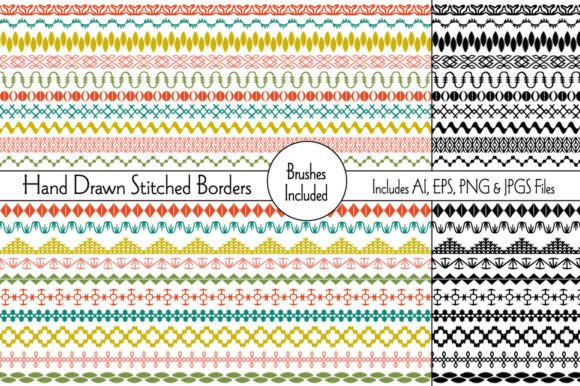
This collection of 20 different hand-drawn embroidery stitch border vector patterns represents more than just decorative lines; it is a toolkit for adding character to visual communications. Available in both vibrant colors and classic black, these patterns are designed to be functional across a wide array of media. Whether utilized for creating decorative frames, custom cards, logos, scrapbook elements, or even digital washi tape, the utility of these assets lies in their adaptability. The inclusion of editable AI and EPS files ensures that professionals can manipulate the brush strokes to fit any point size, length, or color requirement, making them suitable for everything from small web icons to large-format home decor prints.
The Aesthetic Appeal of Simulated Embroidery
The primary draw of hand drawn stitched borders is their ability to evoke the feeling of handmade quality without the labor-intensive process of actual sewing. In a digital environment often characterized by perfect symmetry and sterile lines, the slight irregularities found in hand-drawn stitches introduce a sense of organic movement. This imperfection is intentional and highly valued in modern design theory, as it signals authenticity to the viewer.
When examining the specific characteristics of this collection, one notices the diversity in stitch types. The 20 different patterns likely range from simple running stitches to more complex cross-stitches or blanket stitches. Each variation carries its own cultural and visual weight. For instance, a running stitch might suggest simplicity and folk art, while a denser, multi-colored embroidery pattern could imply richness and tradition. By offering these in both color and black, the collection caters to diverse stylistic needs. Color versions provide immediate visual interest and can be matched to brand palettes, while black versions offer a high-contrast, stencil-like quality that works exceptionally well for logos or monochromatic print projects.
Technical Versatility and File Formats
For professional designers, the value of a graphic asset is often determined by its technical flexibility. This collection distinguishes itself by providing 2 editable AI files and 2 editable EPS files. These formats are the industry standard for vector graphics, allowing for lossless scaling. Unlike raster images (such as standard JPEGs) which become pixelated when enlarged, vector files maintain crisp edges at any resolution. This is crucial for applications ranging from business card logos to large vinyl decals for home goods.
The mention of included brushes within the AI and EPS files is a significant technical advantage. In software like Adobe Illustrator, pattern brushes allow a user to apply a stroke along any path, automatically generating the repeating stitch pattern. This means a designer can draw a circle, a square, or a freeform squiggle, and the hand drawn stitched border will seamlessly conform to that shape. This capability transforms static images into dynamic design tools. Furthermore, the ability to edit the stroke at any point size means that the thickness of the "thread" can be adjusted to suit the medium—thinner for delicate stationery and thicker for bold packaging designs.
Complementing the vector files are 40 JPGs and 40 PNG files on transparent backgrounds. While vectors are ideal for editing, raster files are essential for quick implementation in software that does not support vector editing, such as word processors, basic photo editors, or web content management systems. The PNG format, specifically with transparency, allows these borders to be overlaid on any background color or texture without a white box surrounding them, preserving the integrity of the underlying design.
Practical Applications Across Industries
The utility of hand drawn stitched borders extends far beyond simple decoration. Their application varies significantly depending on the user's intent, spanning commercial, educational, and personal sectors.
Branding and Logo Design
For small businesses, particularly those in the artisanal, food, or craft sectors, branding often relies on conveying a story of handmade quality. A bakery, a knitting shop, or a boutique clothing label can utilize these borders to frame their logos or separate sections on their websites. The embroidery aesthetic subtly communicates values of care, tradition, and attention to detail. Because the patterns are tileable, they can also be used to create seamless background patterns for packaging, wrapping paper, or fabric labels, reinforcing brand identity across all touchpoints.
Scrapbooking and Digital Planning
The rise of digital planning and hybrid scrapbooking has created a massive demand for high-quality decorative elements. Hobbyists who document family histories or organize their lives digitally require assets that look authentic. The 12-inch width and tileable nature of these patterns make them perfect for creating digital washi tape strips. Users can layer these "tapes" over photos or journal entries to add structure and whimsy. The transparent PNGs are particularly useful here, allowing for complex layering without obscuring the photos beneath.
Educational and Instructional Materials
Educators and content creators in the DIY space can leverage these graphics to enhance instructional materials. When teaching crafts, cooking, or gardening, using hand drawn stitched borders to frame worksheets, recipe cards, or presentation slides can make the material feel more approachable and less institutional. The visual language of stitching aligns naturally with topics related to textiles, home economics, and arts and crafts, helping to create a cohesive thematic experience for students or readers.
Home Decor and Gift Creation
On the consumer side, the ability to edit these files opens up possibilities for personalized home decor. With access to the editable AI files, a user could customize a border to include a family name or a specific date, then print it on canvas, wood, or fabric. These elements serve as excellent decorative trim for homemade gifts, such as framing a handwritten letter or decorating a custom tote bag. The "tileable at 1" feature ensures that if a user needs a border longer than the original 12 inches, they can repeat the pattern seamlessly to cover larger surfaces like table runners or wall murals.
Workflow Integration and Customization
Integrating hand drawn stitched borders into a design workflow is straightforward but offers depth for those willing to explore the editable features. For a beginner, the process might involve simply dragging and dropping a PNG file into a document. However, for a power user, the workflow involves opening the AI file, selecting the pattern brush, and applying it to a custom path.
One of the most powerful aspects of this collection is the color editability. While the preview images show specific colorways, the vector nature of the source files means every strand of "thread" can be recolored instantly. A designer working on a winter holiday campaign might shift the palette to cool blues and silvers, while a spring collection might utilize pastels. This flexibility ensures that the asset remains relevant regardless of changing design trends.
Furthermore, the concept of tileability is central to maximizing the value of this pack. A pattern that is tileable at 1 means the end of the pattern matches the beginning perfectly. This allows for the creation of continuous loops. In web design, this can be used to create horizontal dividers that stretch across any screen width. In print, it allows for the creation of borders that fit any page size without awkward cuts or mismatched ends.
Considerations for Effective Use
While hand drawn stitched borders are highly versatile, effective use requires an understanding of context and scale. Because the style mimics embroidery, it carries a specific visual weight. Using these borders on a ultra-modern, tech-focused website might create a dissonant user experience unless the goal is specifically to contrast the organic with the digital. Designers must consider the psychological impact of the stitch; it suggests softness and humanity.
Resolution and output medium are also critical considerations. When using the JPG or PNG files, users must ensure they select the appropriate resolution for their output. For web use, 72 DPI is standard, but for professional printing, the vector AI or EPS files should always be preferred to ensure sharpness at 300 DPI or higher. Relying on the raster files for large format printing could result in blurry edges, undermining the crisp look of the simulated stitching.
Additionally, when editing the vector brushes, attention should be paid to the corner joins. Depending on the software settings, sharp corners in a path might cause the stitch pattern to overlap or distort unnaturally. Skilled users will adjust the corner widgets in their vector software to miter or round the joins, ensuring the "thread" flows smoothly around bends, maintaining the illusion of a continuous physical stitch.
The Broader Impact on Creative Trends
The popularity of assets like this collection reflects a broader trend in design known as "neo-craft" or "digital folk." As society becomes increasingly digitized, there is a counter-movement seeking to reintroduce the aesthetics of manual labor and traditional skills into digital spaces. Hand drawn stitched borders are a prime example of this phenomenon. They allow digital natives to engage with the visual language of their ancestors without needing the physical skills of needlepoint.
This trend is not merely nostalgic; it is functional. In a crowded marketplace, brands that can project warmth and authenticity stand out. The tactile suggestion provided by embroidery patterns triggers a sensory response in the viewer, making the design feel more tangible and trustworthy. For researchers studying visual communication, these elements offer a fascinating case study in how texture influences perception in two-dimensional media.
Ultimately, the value of this collection lies in its balance of specificity and flexibility. It provides a very specific look—the hand-stitched border—but delivers it in a format that is infinitely mutable. Whether used by a professional graphic designer crafting a high-end brand identity, a teacher creating engaging classroom materials, or a hobbyist designing a birthday card, these 20 patterns serve as a foundational element for creativity. The inclusion of comprehensive file formats ensures that no matter the user's skill level or software preference, they can harness the charm of hand drawn stitched borders to enhance their projects.
As the line between physical and digital continues to blur, tools that successfully emulate the beauty of the handmade will remain essential. This collection stands as a testament to the enduring appeal of the stitch, proving that even in a vector environment, the human hand is still the most compelling design tool of all.